


Quick Answer: Dollar Cost Averaging (DCA) — called Rupee Cost Averaging in India — is an investment strategy where a fixed amount is invested at regular intervals regardless of market price. In India, SIP (Systematic Investment Plan) in mutual funds is the most popular form of DCA. When markets are down, your fixed amount buys more units; when markets are up, it buys fewer. Over time, this averages your purchase cost and reduces the impact of market volatility on long-term returns.
Market upar jaaye ya neeche — ye predict karna kisi ke bas ka nahi hai. Warren Buffett ne bhi kaha hai ki woh kabhi consistently market time nahi kar paaye. Toh agar duniya ke sabse bade investor ko timing nahi aati, hum aur tum kahan se seekhenge?
Lekin ek strategy hai jo timing ki zaroorat hi khatam kar deti hai — Dollar Cost Averaging (DCA). India mein ise Rupee Cost Averaging (RCA) bhi kehte hain, aur practically ye SIP ke roop mein already crores of Indians use kar rahe hain — bina jaane ki ye ek globally proven investment strategy hai.
Socho — ek banda har mahine ₹10,000 invest karta hai, chahe market 50,000 pe ho ya 40,000 pe. Jab market 40,000 pe hai, uske ₹10,000 mein zyada units milte hain. Jab 50,000 pe hai, kam units milte hain. Over time, uski average purchase cost market ke average se kam ho jaati hai — aur yehi DCA ka magic hai.
Chahe beginner investor ho ya experienced — DCA ki sahi samajh tumhara investing significantly better bana sakti hai.
What is Dollar Cost Averaging (DCA)?
Dollar Cost Averaging is an investment strategy in which a fixed rupee amount is invested into a specific asset — such as a mutual fund, stock, or ETF — at regular, predetermined intervals, regardless of the asset's current price.
In India, since we invest in rupees, the equivalent concept is called Rupee Cost Averaging (RCA) — but both terms are used interchangeably in Indian financial discussions.
The Core Mechanism
- When price is HIGH: Fixed amount buys FEWER units
- When price is LOW: Fixed amount buys MORE units
- Result: Average cost per unit is LOWER than the average price over the same period
This is a mathematical certainty — you automatically buy more when things are cheap and less when things are expensive, without any active decision-making.
| Approach | Timing Risk | Emotional Risk | Best For |
|---|---|---|---|
| Lumpsum | Very High | High | When markets are clearly cheap |
| DCA / SIP | Very Low | Very Low | Regular income investors |
| STP (Systematic Transfer) | Low | Low | Windfall/bonus deployment |
How Rupee Cost Averaging Works — With Numbers
Rohit invests ₹5,000 every month in a Nifty 50 Index Fund. The NAV fluctuates each month:
| Month | NAV (₹) | Investment (₹) | Units Purchased |
|---|---|---|---|
| January | 100 | 5,000 | 50.00 |
| February | 80 | 5,000 | 62.50 |
| March | 60 | 5,000 | 83.33 |
| April | 70 | 5,000 | 71.43 |
| May | 90 | 5,000 | 55.56 |
| June | 110 | 5,000 | 45.45 |
| Total | Avg ₹85 | ₹30,000 | 368.27 |
Average NAV: ₹85 | DCA average cost: ₹30,000 ÷ 368.27 = ₹81.47 — lower by ₹3.53/unit.
| Strategy | Value at June (₹110 NAV) | Return |
|---|---|---|
| DCA (₹5,000/month) | ₹40,510 | 35% |
| Lumpsum ₹30,000 in January | ₹33,000 | 10% |
DCA gave 35% vs Lumpsum's 10% — because markets dipped in between and DCA bought heavily during the dip.
Why DCA Works — Mathematical and Psychological Reasons
Mathematical Reason — Harmonic Mean Effect
When you invest a fixed rupee amount at varying prices, your average cost per unit is the harmonic mean of all prices — which is always lower than the arithmetic mean (simple average) as long as prices fluctuate. This is a mathematical certainty — not a prediction or a bet.
Psychological Reason — Removes Emotion from Investing
Investor psychology is the biggest enemy of investment returns. Studies consistently show that average investors buy at tops (FOMO) and sell at bottoms (panic). DCA eliminates this emotional cycle entirely:
- When market is down → DCA automatically buys MORE (cheap units)
- When market is up → DCA automatically buys LESS (expensive units)
- No decision needed → No emotional interference
Behavioral finance research (including Nobel Prize-winning work by Daniel Kahneman) shows that the pain of losses is felt 2x more intensely than the pleasure of equivalent gains. DCA reduces this psychological pain — each dip becomes a buying opportunity, not a loss event.
DCA in Different Indian Investment Instruments
DCA Strategies for Indian Investors
Strategy 1 — Basic Monthly SIP (For Beginners)
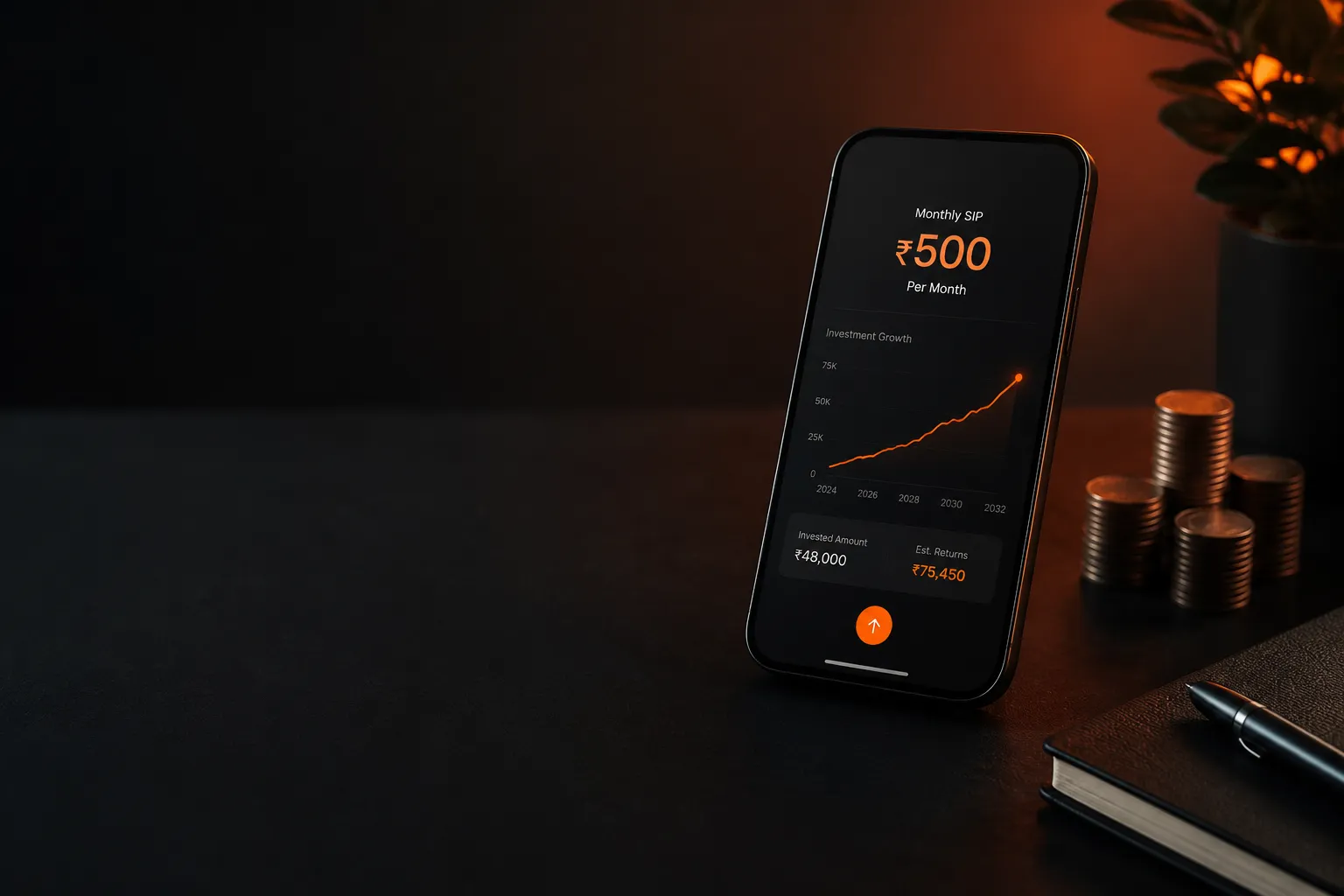
Start one or two equity mutual fund SIPs and automate them. Choose 1–2 funds (Nifty 50 Index Fund + Flexi Cap Fund). Set SIP date 3–5 days after salary credit. Start with ₹500–₹1,000/month, increase as income grows. Minimum tenure: 7–10 years.
Strategy 2 — Step-Up DCA (Advanced Beginner)
Start with a base SIP amount and increase it by 10% every year — aligned with salary increases.
| Approach | Total Invested (20 yrs) | Corpus at 12% CAGR |
|---|---|---|
| Flat SIP ₹3,000/month | ₹7,20,000 | ~₹29,97,000 |
| Step-Up SIP 10%/year | ₹22,84,650 | ~₹83,20,000 |
Step-up DCA creates ₹83 lakh vs flat DCA's ₹30 lakh — same starting amount, just by increasing with salary growth.
Strategy 3 — Multi-Asset DCA (For Intermediate Investors)
DCA simultaneously into multiple asset classes — ₹20,000/month total:
- ₹12,000 → Equity Fund SIP (60%)
- ₹6,000 → Debt Fund SIP (30%)
- ₹2,000 → Gold Fund SIP (10%)
Natural rebalancing through DCA — when equity is down, your equity SIP buys more cheaply while other allocations continue unaffected.
Strategy 4 — Value Averaging (Advanced DCA)
Instead of fixed amount, invest whatever is needed to bring portfolio to a predetermined growth target each month. You automatically invest MORE when markets are down and LESS when up — even stronger than regular DCA. Requires active monitoring — not easily automated.
Strategy 5 — Opportunistic DCA (For Experienced Investors)
Maintain regular monthly SIP PLUS invest additional lump sums during significant market corrections:
- Regular: ₹10,000/month SIP — always running
- Nifty falls 15% from peak → Deploy ₹50,000–₹1,00,000 additionally
- Nifty falls 25% → Deploy another large lumpsum
When DCA Works Best — and When It Doesn't
Real Numbers — Examples
Example 1 — Kavya (DCA) vs Amit (Lumpsum) — 2019 to 2024
Both have ₹6 lakh to invest in January 2019.
| Investor | Strategy | Return (5 yrs) | COVID Stress |
|---|---|---|---|
| Kavya | DCA ₹10,000/month | ~75% (XIRR 12.8%) | Low (only ₹1.4L invested by March 2020) |
| Amit | Lumpsum ₹6L in Jan 2019 | ~94% (CAGR 14%) | Extreme (₹6L dropped to ₹3.9L) |
Amit's lumpsum won in this scenario — but he watched ₹6 lakh drop to ₹3.9 lakh in March 2020. Most real investors panic-sell at this point, destroying all future gains. Kavya's DCA gave slightly lower returns but dramatically lower stress and near-zero panic-sell risk.
Example 2 — Meera's 15-Year DCA Journey (₹5,000/month, 2009–2024)
Meera never tried to time the market. She never panicked during crashes. She just kept her ₹5,000 SIP running — 15 years of DCA created ₹28 lakh from ₹9 lakh. No skill required. Just consistency.
DCA and Emotional Investing — The Behavioral Edge
| Situation | Lumpsum Investor | DCA Investor |
|---|---|---|
| Before investing | Worried about "right time" | No timing decision needed |
| Market crash (-30%) | Watching ₹10L drop to ₹7L — panic | "I'm buying cheap units now" |
| Probability of panic sell | High | Much lower |
| Recovery participation | Partial (if panic-sold) | Full + extra cheap units |
The best investment strategy is the one you can stick to through market cycles. For most humans, DCA is that strategy.
Pro Tips
SIP band mat karo market girne pe — DCA ka asli faayda tabhi milta hai
Jab market 20–30% girta hai, tumhara dil kehta hai "SIP band karo, paisa bachao." Lekin yahi woh waqt hota hai jab tumhara SIP sabse zyada units khareed raha hota hai — cheapest price pe. Crash ke time SIP band karna DCA ke poore benefit ko destroy kar deta hai.
Step-Up SIP feature use karo — ye DCA ko turbocharge karta hai
Flat SIP bhi bahut accha hai. Lekin 10% annual step-up add karo aur corpus almost 2–3x ho jaata hai same tenure mein. Groww, Zerodha Coin, Kuvera pe step-up SIP option available hai — ek baar set karo, automatically har saal amount badh jaata hai.
Multi-asset DCA karo — sirf equity mein concentrate mat karo
₹10,000/month ko — ₹6,000 equity, ₹3,000 debt, ₹1,000 gold mein split karo. Multi-asset DCA ensures ki tum har asset class mein average cost benefit pao, aur portfolio naturally balanced rehta hai through simultaneous averaging.
Windfall aaye toh STP use karo — DCA ka lumpsum version
Bonus, inheritance, ya koi bada amount mile toh directly equity mein mat daalo — STP (Systematic Transfer Plan) use karo. Paisa liquid fund mein daalo, phir monthly equity mein transfer karo — lumpsum ka return potential + DCA ka risk reduction. Best of both worlds for large amounts.
DCA performance XIRR se measure karo — absolute returns se nahi
Simple percentage return sirf lumpsum ke liye accurate hai. SIP/DCA ke liye XIRR (Extended Internal Rate of Return) use karo — ye time-weighted return accurately calculate karta hai for irregular cash flows. Groww aur Value Research XIRR automatically show karte hain.
Common Mistakes
"Market sahi level pe aayega phir SIP shuru karunga"
DCA ka whole point timing ki zaroorat eliminate karna hai — aur phir bhi log timing wait karte hain DCA shuru karne ke liye. Ye paradox hai. SIP shuru karne ke liye market ka level dekhna zaroorat nahi — aaj shuru karo. 10 saal baad aaj ki entry price irrelevant hogi compounding ki wajah se.
DCA amount bahut chhota rakhna aur kabhi nahi badhana
₹500/month se shuru karna theek hai — lekin 5 saal baad bhi ₹500 pe rehna galat hai. Flat ₹500/month for 20 years creates ~₹5 lakh. ₹500 step-up 10%/year with same tenure creates ~₹15+ lakh. Income badhne ke saath amount badhao.
SIP ek fund mein karna aur kabhi review nahi karna
DCA disciplined hona chahiye — lekin blind nahi. Saal mein ek baar check karo ki fund accha perform kar raha hai benchmark ke against ya nahi. Agar fund consistently underperform kar raha hai 3 saal se zyada — switch karo better fund mein. DCA discipline ≠ never reviewing your fund.
Returns short-term mein compare karna aur disappointed hona
DCA 1–2 saal mein spectacular returns guarantee nahi karta — ye long-term tool hai. 3 saal mein 8% return dekhke disappointed ho jaana aur SIP band karna — ye biggest mistake hai. 7, 10, 15, 20 saal ke perspective mein DCA ko judge karo. Short-term comparison DCA ke saath meaningless hai.
Emergency fund ko DCA/SIP mein include karna
Kuch log apna emergency fund bhi SIP mein daal dete hain — "better returns milenge." Ye dangerous hai. Agar emergency aaye aur market 30% neeche ho, tumhe loss mein redeem karna padega. Emergency fund (3–6 months expenses) hamesha liquid — savings account ya liquid fund — mein rakho. DCA sirf surplus income ke saath karo.
Key Takeaways
- DCA = Rupee Cost Averaging = India mein SIP — ye ek globally proven strategy hai jo Indian investors pehle se use kar rahe hain SIP ke naam se — mostly bina jaane ki ye ek powerful investment philosophy hai.
- Mathematical certainty hai ki DCA average cost ko average price se kam rakhta hai — jab tak prices fluctuate karein (jo hamesha hota hai), DCA automatically cheap mein zyada aur expensive mein kam khareedta hai.
- Behavioral edge sabse underappreciated benefit hai — DCA tumhe panic-selling se bachata hai, timing ki tension se bachata hai, aur market crash ko opportunity mein convert karta hai psychologically.
- Step-Up DCA game changer hai — 10% annual increase flat SIP se almost 2–3x zyada corpus create karta hai same tenure mein. Ye feature zaroor use karo.
- Multi-asset DCA ideal hai — sirf equity mein nahi, debt aur gold mein bhi simultaneously SIP karo — natural rebalancing + averaging across all asset classes.
- DCA long-term tool hai — 7 saal minimum, 15–20 saal ideal — short-term mein judge mat karo. DCA ki shakti time ke saath exponentially badhti hai.
Calculate Your DCA Returns
Enter monthly SIP amount and tenure — see exact corpus projection. Then try step-up to see the difference 10% annual increase makes.
Also read: Power of Compound Interest · Portfolio Rebalancing Guide · Gold vs SGB vs ETF